How to Store Apples Over Winter So They Last Until Spring
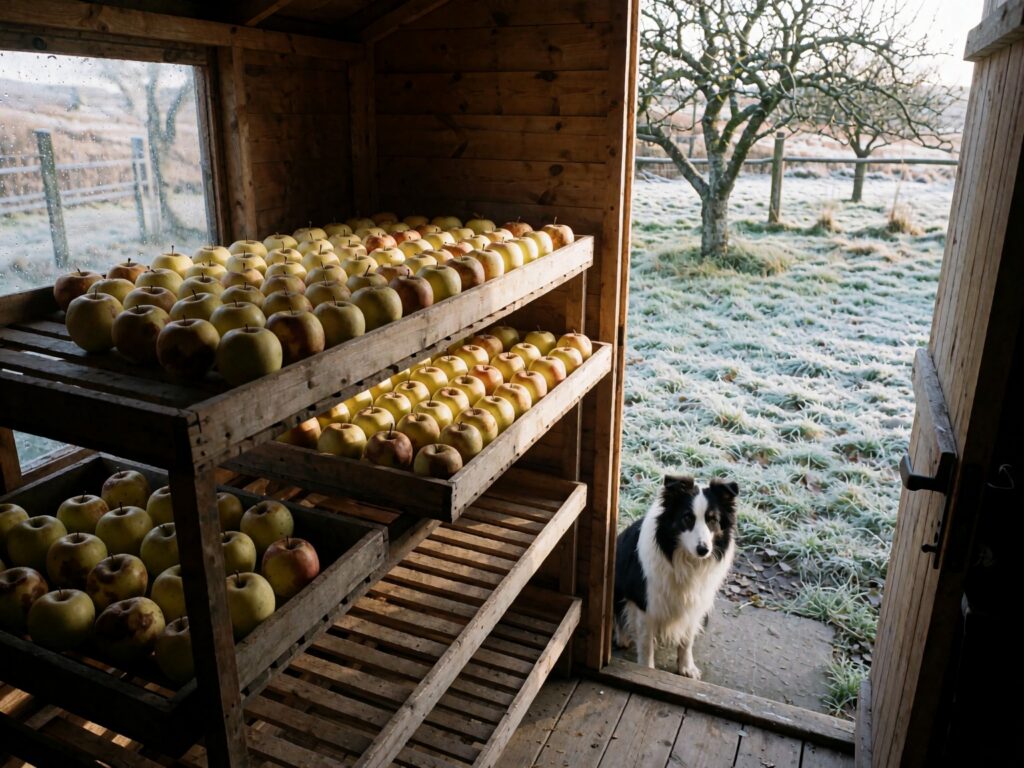
Why do some apples go soft and brown by Christmas while others, picked off the same tree, are still crisp at Easter? It isn’t luck. It’s how they were picked, how they were sorted, and where they sat for the next five months. Get those three things right and an ordinary cooking apple will outlast most of what’s on a shop shelf.
I learned this the hard way my first autumn at High Intake. I’d picked a trug of Bramleys, tipped them straight into a box in the shed, and by December half of them had gone to mush, with the brown creeping into the good ones next to them. Whisky got the blame at the time, mostly because she was the only one in the shed with me and couldn’t argue back. The fault was mine, and it’s a common one.
When to pick them
An apple that’s picked too early never stores well, no matter what you do to it afterwards. The test the RHS gives, and the one I use, is simple: cup the apple in your hand, give it a gentle twist, and if it comes away with the stalk still attached, it’s ready. If you have to tug or wrench it, leave it another week.
Up here on the moor edge, around 200 metres, the main keeper varieties, your Bramleys, your Howgate Wonders, your late Russets, are usually ready through the back end of October into early November. If your garden sits down on lower ground, say 150 to 200 metres below that, you can expect to be picking a good fortnight earlier, because the season simply runs ahead of mine. If you’re higher still, add roughly a week for every hundred metres you climb. It isn’t an exact science, but it saves a lot of guessing, and it’s the rule I give anyone who writes in asking why their apples are weeks behind what a book tells them.
The other thing worth watching is frost, not because a touch of frost ruins an apple on the tree, it rarely does, but because a hard frost followed by a quick thaw can bruise the flesh invisibly, and a bruised apple is the one that rots first in store. I check the Met Office’s local forecast before a picking session in late October, and if a sharp frost is forecast for the next night or two, I’d rather bring the crop in a day early than leave it out for it.
Sorting before you store anything
This is the step people skip, and it’s the one that matters most. Every apple goes through my hands twice before it goes anywhere near the shed. First pass: anything with a split skin, a soft patch, a wasp hole or obvious bruising goes in a separate box, the “use this week” box, not the store. Second pass, a day or two later once I can see how they’re settling: anything that’s started to weep or darken comes out again.
The old saying about one bad apple spoiling the barrel isn’t folklore, it’s basic biology. A rotting apple gives off ethylene gas, which speeds up ripening and softening in everything around it. Garden Organic’s advice, which matches what I was taught years ago, is to store only sound, undamaged, unbruised fruit, and to check the whole batch every few weeks through winter, pulling out anything that’s turned. Ten minutes with a torch and a crate, once a fortnight, is the difference between a store that lasts to April and one that’s half gone by January.
- Pick only fruit with no splits, soft spots or insect damage for long storage
- Keep the stalk on where you can, it slows moisture loss through the top of the apple
- Never wash apples before storing, a dry skin keeps better than a damp one
- Store each variety separately where you can, as some ripen faster than others and will hurry their neighbours along
Where to keep them
A cold shed, garage or outbuilding does the job far better than anything indoors, and this is where a northern garden has the advantage over a southern one. The RHS recommends a storage temperature between about 2 and 7 degrees, which most unheated outbuildings sit at naturally through a Yorkshire winter without you doing a thing. What you’re after is somewhere cool, dark, and a little bit damp, rather than bone dry, since very dry air shrivels the skin.
I lay mine out in old seed trays, one layer deep, apples not touching each other, in the coolest, darkest corner of the shed, away from the door where the temperature swings most when it’s opened and closed. Some people wrap each apple individually in newspaper, which does slow the spread of rot if one does turn, though with regular checking I’ve not found it essential for a modest crop. If mice are a worry in your shed, as they sometimes are in mine, raise the trays off the floor on a couple of bricks or an old pallet.
Apples don’t like company in storage either. Keep them well away from potatoes and onions, which give off their own gases and moisture, and away from anything with a strong smell, since apple flesh takes on odours easily. Whisky has her own views on which corner of the shed is hers and which is mine, and we’ve come to an arrangement that keeps both the apples and her bed dry.
Checking through the winter
A store left to itself from November to March will let you down. Go through it every two to three weeks, take out anything that’s softened or marked, and use those first in a crumble or a chutney rather than wasting them. Bramleys cook down beautifully even past their best for eating fresh, so very little needs to go to waste if you catch it early.
Done properly, from a careful pick in late October to a last check before the first daffodils, a good store of Bramleys or Howgate Wonders will see you through to March or even April, by which time the first of the new season’s rhubarb is usually keeping me busy instead. There’s a quiet satisfaction in going out to a cold shed in February and coming back with a sound apple for your porridge, grown and kept by your own hand, long after the supermarket’s own crop from the same fields has given up.
