When It’s Safe to Plant Out After the Last Frost in the North of England
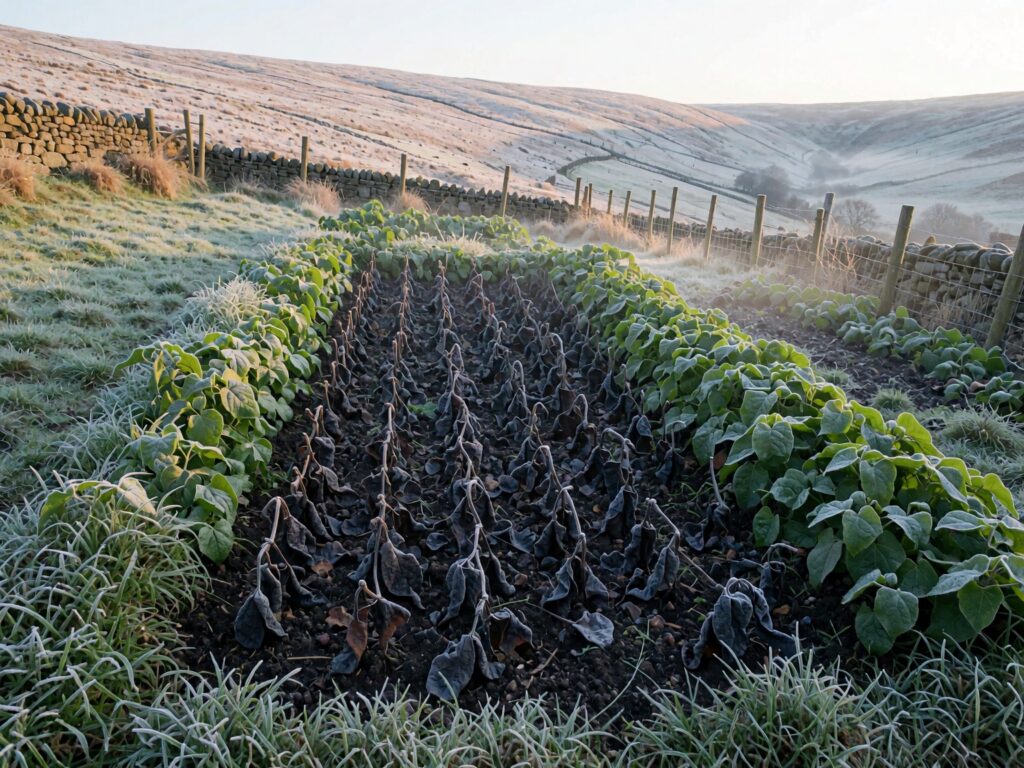
Ask anyone in a garden centre when the last frost falls and you’ll get a date worked out for a garden somewhere in the south, not for a smallholding on the edge of the North York Moors. Up here, at around 200 metres, which is the height I’ll use for everything in this piece, the last frost that actually matters for planting out has, in my own years of watching this ground, usually come somewhere in the last week of May to the first week of June, and some springs it’s pushed later than that again. That’s my own garden’s reckoning rather than an official figure for this exact spot, so take it as a starting point rather than a guarantee, and I’ll come back to how you can check it against your own ground. If you’ve ever set out your runner beans on a date you read in a magazine and watched them go black and papery a week later, you already know the problem. The date wasn’t wrong for wherever it was written for. It just wasn’t written for here.
What “last frost date” actually means
The Met Office keeps long runs of daily minimum temperature records for stations right across the country, and from those you can work out, for any given place, how late into spring frost has turned up in past years. That’s where a last frost date comes from. It isn’t a promise. It’s closer to the sort of odds a bookmaker would give you: a date after which frost becomes unlikely, not a date after which it becomes impossible. Even in a kind spring, a late cold snap can still catch you out, and a hard frost in June isn’t unheard of on exposed ground, though it is rare.
There’s also a difference worth knowing between an air frost and a ground frost. An air frost is what the forecast means when it says frost, measured a bit above the ground. A ground frost happens right down at soil level, on a clear, still, cold night, even when the air a metre up never quite gets there. Ground frost is the one that catches gardeners out, because it can nip the tender top growth of a plant while the thermometer on the wall says nothing alarming at all. Up here, with the moor behind the house pulling the warmth out of a clear night, I’ve lost seedlings to a ground frost on an evening that felt, by the time I went to bed, entirely mild.
Why height and shelter take weeks off each other
This is the part that most general advice skips, and it’s the part that matters most if you garden anywhere north of the Trent or anywhere with a view. Cold air is heavy, and it slides downhill and pools in valley bottoms the way water does, while it slides off higher, more exposed ground. As a rough working rule, consistent with the pattern in the Met Office’s own records for stations at different elevations, you can expect the last frost to come roughly a week later for every 100 metres you climb, and roughly two weeks earlier on low ground that sits somewhere 150 to 200 metres below a place like High Intake. Starting from my own garden’s reckoning above, that would put a garden down in the dale, well below the moor, clear of frost by roughly early to mid May, while a garden on a shoulder of moorland at 300 metres might not be properly safe until around the middle of June. Those are estimates built on the local pattern rather than a certified date for your own postcode, so still watch your own ground as the season turns.
Shelter does its own work on top of height. A walled garden, a south-facing yard, the lee side of a barn, all of these hold a little more warmth than open ground, and can knock several days off the date for whatever you’re growing right against them. The opposite is true too. A spot where cold air collects, at the bottom of a slope with no way out, or a frost pocket where the field dips, will run colder and later than the rest of your own plot, sometimes by a surprising margin. I learned this the hard way in my first spring here, when the cabbages nearest the gate, right where the land dips before it rises again towards the moor, were caught twice while the same variety six yards away, up on the higher bed, sailed through untouched. Whisky has never once cared about any of this, and would happily lie out in a frost if I let her, but she has the sense to come in when I open the door.
How to tell when it’s actually safe
A date on a page is a starting point, not a verdict, and the RHS gives much the same advice: treat any published last frost date as a guide for your region, then watch your own ground. A few things are worth checking each year rather than trusting the calendar alone.
Keep an eye on the forecast for clear, still nights, because those are the ones that let heat escape straight up and the temperature drop fastest, far more than a cloudy, breezy night ever will, even if the daytime high was lower. The usual advice for gardeners in colder districts is to wait for a settled run of mild nights, not just one or two warm days, before trusting that the season has properly turned. Older country wisdom up here has always pointed to the hawthorn, waiting until the blossom is properly out in the hedges before trusting tender plants to open ground, and while I wouldn’t stake a greenhouse full of tomatoes on a hedge alone, it tends to agree with what the records say for this height.
It’s also worth remembering that different plants have different nerve. A light ground frost will barely trouble kale, broad beans or sweet peas, all of which shrug off a cold morning that would finish off a courgette or a dahlia overnight. Knowing which of your plants are the genuinely tender ones, and which can take a scare and carry on, saves you either losing plants early or holding everything back for weeks longer than it needs.
What to do with tender plants until that date arrives
None of this means sitting on your hands until June. Seedlings can go out into a cold frame or an unheated polytunnel well before the open ground is safe, and harden off there gradually, with the lid or the door opened a little further each day so the plants get used to the cooler air without a shock. Horticultural fleece, kept to hand and thrown over anything newly planted on a night that looks likely to turn clear and cold, will often be enough to see off a light frost, though it won’t save a plant from a hard one. If in doubt on any given night, it costs nothing to check the forecast for a clear sky and a calm wind and throw the fleece over regardless. I have never once regretted covering something that didn’t need it, and I have very much regretted not covering something that did.
For the first spring, if you don’t yet know your own plot’s habits, I’d treat the figure for your height and shelter as the earliest sensible date, then watch the ground and the forecast for the final go-ahead rather than marking it in the diary and forgetting about it. A last frost date tells you when the odds turn in your favour. It’s still you, out at dusk with one eye on the sky, who decides the actual day.
