Greenhouse or Polytunnel for a Windy Northern Plot
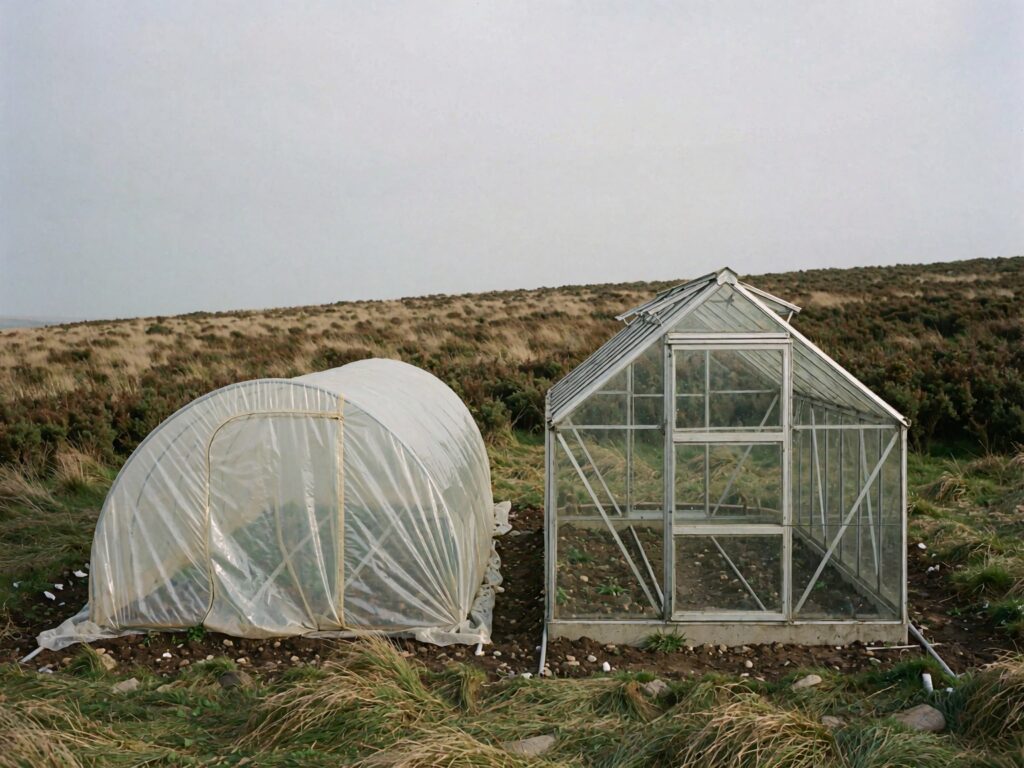
Which one actually survives up here, a greenhouse or a polytunnel? If your plot catches wind off open fields, a hillside or the moor itself, a well anchored polytunnel generally copes better with gusts than a greenhouse does, but a greenhouse holds its warmth and light more evenly once the wind finally drops. Neither is simply the better choice. It depends on what the wind does to your particular patch of ground, what you want to grow in it, and what you can afford to put up in the first place.
I garden at High Intake, on the edge of the North York Moors, where the wind comes off the tops with nothing to slow it down between here and the sea. Whisky, my border collie, has a particular low bark reserved for the nights it really gets going, and after a few winters here I’ve learned to take her word for it before I take my own. So this isn’t theory. It’s what I’ve watched happen to both kinds of structure, set against what the RHS, the Met Office and Garden Organic actually say rather than what sounds sensible on a calm afternoon in the shop.
What the wind actually does to each one
A polytunnel flexes. The hoops bend a little under a gust and the polythene skin moves with the wind rather than standing square against it, which is exactly why a tunnel on a well anchored, well tensioned frame tends to ride out weather that would rack a glasshouse. The RHS’s guidance on siting either structure comes back to the same point again and again: it isn’t the covering that fails first in wind, it’s the fixing. A tunnel needs its base rails sunk properly and its ground anchors driven deep, not just pegged, or the whole thing will walk across the plot in the first real storm. I’ve seen it happen to a neighbour’s tunnel two winters back. It ended up against the hedge, cover torn, frame more or less intact.
A greenhouse, by contrast, is rigid. That’s its strength in a still spell and its weakness in a gale, because rigid things crack or shift rather than give. Glass panes can crack in a hard gust carrying grit or hail, and an aluminium frame that isn’t bolted to a solid base, or better still a dwarf wall, can rack out of true over a few bad winters. The RHS reckons on a polytunnel’s polythene cover lasting roughly four to five years before UV finally breaks it down, less on a genuinely exposed site, whereas a glasshouse, properly based and maintained, will easily outlast several tunnel covers. So the trade is really this: the tunnel needs replacing in parts but seldom destroys itself outright, while the greenhouse lasts longer overall but is less forgiving of a single bad night if it isn’t anchored properly from the start.
What it costs, honestly
A polytunnel is cheaper to get started with for the same growing area, and most of what you’re paying for is the steel hoop frame, the base rails and the anchors, not the covering itself. The covering is also the part you’ll pay for again, every four or five years, so a tunnel’s real cost is spread out rather than paid once. A greenhouse costs more to buy outright, particularly if you go for toughened glass over polycarbonate, but once it’s up and properly based it asks very little of you beyond the odd replacement pane after a storm, and the occasional repaint or re-putty on an older timber frame.
Where people get caught out on both is the base. A tunnel without deep enough anchors and a greenhouse without a solid, level footing are both false economies, because the structure itself is never really the weak point. The fixing is. Spend properly on the base before you spend on the kit, whichever one you choose.
Light and what each will actually grow
Polythene scatters light. That sounds like a disadvantage until you remember what it does for young plants: diffused light reaches right round a leaf rather than scorching one side of it, which is part of why a tunnel suits closely packed beds of tomatoes, cucumbers, early potatoes and salad right through a long season. Garden Organic’s guidance on extending the growing year points to the same thing I’ve found at High Intake: any cover, tunnel or glass, buys you several extra weeks at each end of the season, simply because the frost arrives later underneath it and the soil holds its warmth for longer.
Glass lets more direct light through on a bright day, which means a greenhouse warms faster in brief spells of sun and is the better place for pots, staging and anything you want to keep a close eye on, seedlings on a heated mat, tender perennials you’re overwintering, cuttings you’re coaxing on. It also cools faster once the sun goes, because glass holds far less heat than the ground a tunnel is built straight over. That’s why a tunnel tends to win on soil-grown crops through a long northern season, and a greenhouse tends to win on anything you’re growing in a pot and want to manage closely.
So which one for your plot
If your ground is genuinely exposed, moor edge, hilltop, open coast, I’d lean towards a polytunnel put up properly, with deep anchors and, ideally, some kind of windbreak, a hedge, a fence, even straw bales for the first year or two, set up before the tunnel rather than after. A greenhouse only earns its keep on a plot like that if you can give it real shelter and bolt it down hard, because a cracked pane in January is not a cheerful job.
Whichever you choose, be honest with yourself about dates. Everything in this piece is reckoned from here at High Intake, on the edge of the moor at around 200 metres. Down on lower ground, say 150 to 200 metres below that, you can usually count on the last frost arriving a good fortnight earlier. Climb another 100 metres and add roughly a week to whatever date you’d otherwise plan around. Either structure will buy you several weeks either side of your local last frost, but neither one abolishes it outright. An unheated tunnel or greenhouse on a clear, still night will still drop close to freezing inside, and more than one gardener up here has lost a tray of young plants to being a fortnight too confident.
Choose the one that will still be standing, and still doing its job, on the night Whisky decides to bark at the wind.
