When to plant potatoes up north
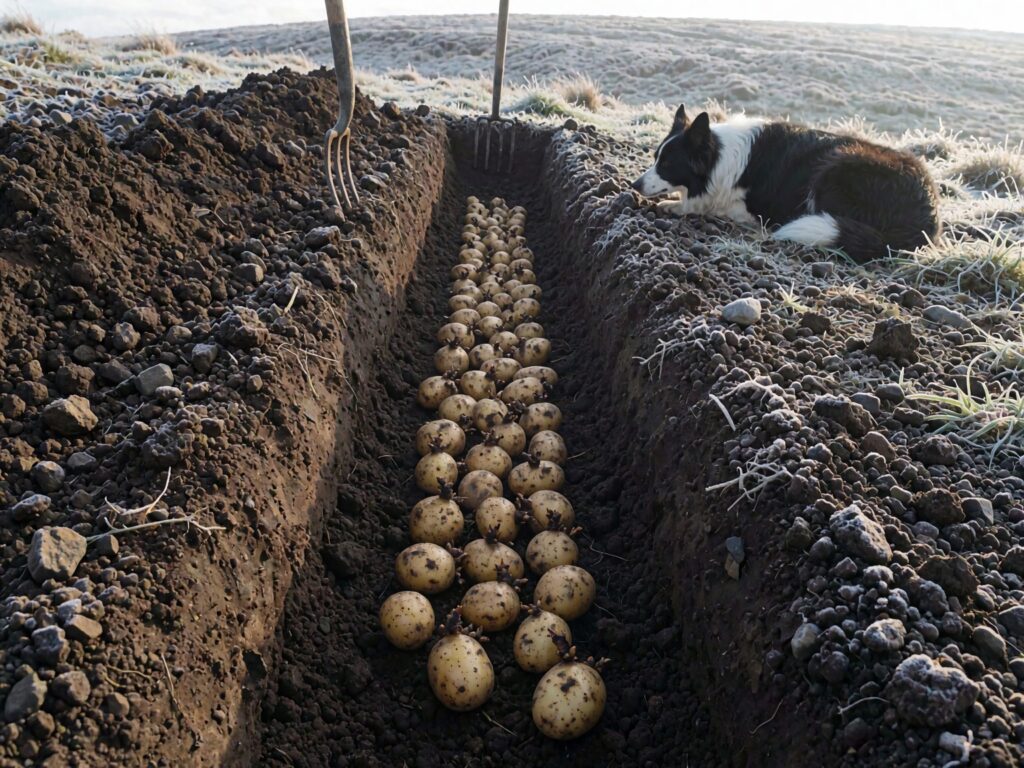
When should you plant potatoes if you garden somewhere cold? The honest answer is later than the seed packet thinks, and in three separate goes rather than one. First earlies, second earlies and maincrop potatoes all want different weeks in the ground, and once you’re up on a moor edge or a few hundred feet above the valley floor, every one of those dates needs pulling back. I’ve been growing potatoes at High Intake for a few years now, on a plot that sits at around 200 metres with the wind coming straight off the moor, and I’ve learned to treat the seed packet as a starting point, not an instruction.
Whisky, my border collie, has her own view of potato planting, which is that any disturbed soil is an invitation to help. She has flattened more than one row of chitted tubers simply by lying on them in the sun. I mention this because it’s the kind of thing a seed packet never warns you about, and because it’s a fair example of how the real world interferes with the tidy plan.
What’s the difference between first earlies, second earlies and maincrop?
The difference is how long each type needs in the ground, and that’s what drives the planting order. First earlies are the quickest, ready in around ten to thirteen weeks, and they’re what most people mean by “new potatoes”. Second earlies take a bit longer, more like thirteen to sixteen weeks, and give you a slightly bigger potato with good flavour. Maincrop varieties are the long haul, wanting something like fifteen to twenty weeks, and they’re the ones that store best over winter, which matters a good deal if you’re trying to feed yourself through a northern February.
The RHS gives rough cropping windows along these lines, and Garden Organic’s growing guides agree on the broad pattern: earlies first, then second earlies, then maincrop last. That order isn’t arbitrary. Earlies go in first because they’re the ones you’re racing to get out of the ground before blight season gets going properly, and because a quick crop can dodge a run of bad weather that a slower one can’t. Maincrop goes in last partly because it’s in no hurry, and partly because by the time you’re planting it, the frost risk has usually dropped enough that you’re not gambling the whole row on one mild week in April.
When do I actually plant each type up here?
Every date I give you is for the moor edge, somewhere around 200 metres, the same height as High Intake. If you’re down on lower ground, say 150 to 200 metres below that, you can generally bring the dates forward by about two weeks. If you’re higher than me, add roughly a week for every hundred metres you go up. That’s not a precise science, more a rule of thumb that’s served me well, but it does mean a date that’s safe in a sheltered valley garden can still catch you out on an exposed hillside.
For first earlies at my height, I’m chitting from late February and planting out in the last week of March or the first week of April, once I’m confident the worst of the hard frosts are behind us. Second earlies follow on a couple of weeks later, so early to mid-April for me. Maincrop goes in last, generally mid to late April, by which point the soil has usually warmed enough to get things moving without rotting the seed potato in cold, wet ground.
I check all of this against the Met Office’s local frost data before I commit a single tuber to the soil, because a date that worked two years running can still catch you out the third year. The average last frost for my part of the North York Moors tends to sit somewhere in late April, sometimes creeping into early May in a slow spring, and that’s a different calendar entirely from somewhere in the Vale of York twenty miles away and a few hundred feet lower.
Why chit potatoes before planting, and how do you do it?
Chitting means standing your seed potatoes somewhere cool, light and frost-free, usually in an egg box or a seed tray, with the end that has the most eyes facing upwards. Over several weeks, short sturdy shoots grow from those eyes. It’s not essential for maincrop, which has plenty of time to catch up, but for first and second earlies it genuinely helps, because it gives the plant a head start before it even touches the soil. The RHS reckons chitted earlies can crop a week or two sooner than unchitted ones, which up here, where the growing season is already shorter than most of the country enjoys, is not a week or two you want to throw away.
I start chitting mine in a cold frame against the stone wall on the sheltered side of the house, which gets enough light without getting hammered by the wind that comes straight off the moor most afternoons. If your shoots come up long, pale and leggy, that’s usually a sign they want more light and less warmth, not more of either. A windowsill in a heated room is often too warm for good chitting; somewhere cooler and brighter, like an unheated porch or shed with a window, tends to do the job better.
How do you protect potatoes from a late frost?
Even with the dates above, a late frost up here is a when, not an if, and the top growth of a potato plant is not forgiving of it. A hard frost can blacken the leaves right down to the soil overnight, and while the plant will often recover from one knock, it costs you growth and, in a bad year, it can cost you the crop if it happens more than once.
The simplest protection is earthing up, which means drawing soil up around the stems as the plant grows, covering the lowest leaves and giving a bit of insulation to anything still close to the ground. Beyond that, horticultural fleece thrown over the rows on a night when frost is forecast makes a real difference, and it’s cheap enough to keep a roll of it by the back door through April and May. Garden Organic also suggests covering emerging shoots with a layer of straw or dry leaves on a cold night, which works reasonably well if fleece has blown off somewhere, as mine occasionally does when the wind gets up.
If you do lose top growth to a frost, don’t dig the row up in despair. In most cases the potato itself is unharmed below ground, and new shoots will come through within a week or two. I’ve had rows blackened by frost in early May and still harvested a perfectly respectable crop come July, simply because I left them alone and let them get on with it.
What if you’re not sure how exposed your own plot is?
Height above sea level is the main factor I use, but it isn’t the only one. A plot in a dip where cold air pools on a still night can run colder than a plot on a slope at the same height, simply because frost rolls downhill and settles. A walled garden or a spot in the lee of a building will often run a week or so ahead of an open field at the same elevation, because it’s sheltered from the wind that does so much of the damage up here. The best check, if you’re new to a plot, is simply to keep a note of your own frosts for a year before you plant anything precious, and build your dates around what actually happens on your ground rather than what a chart says should happen.
Plant your first earlies when the soil’s workable and the worst frosts look past, your second earlies a fortnight behind them, and your maincrop once the ground’s properly warmed through, and shift every one of those dates for your own height and shelter. Get that right, and the rest of it, the earthing up, the fleece on a cold night, the patience when a frost blackens a leaf, is just steady work rather than guesswork.
