What to Grow in a Polytunnel Through the Year
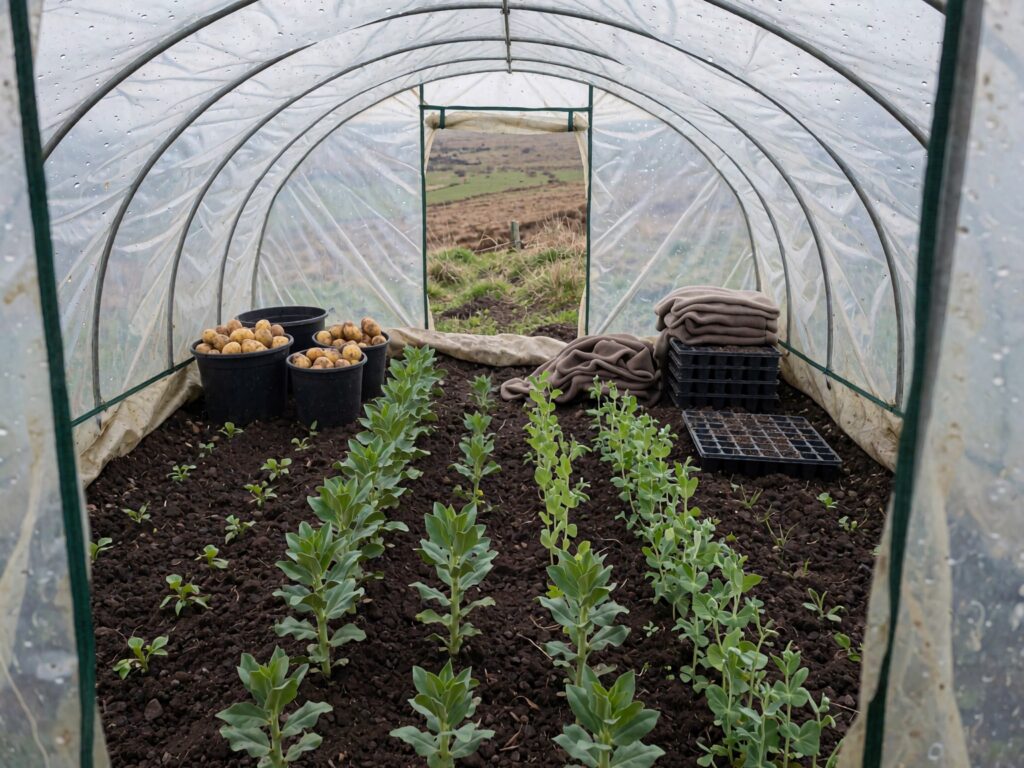
If you’re asking what you can actually grow in a polytunnel across the year, the honest answer is more than most people expect, even on a windy site like mine. I’m writing from High Intake, on the edge of the North York Moors at around 200 metres, and every date below is set for that height. Go down to lower ground, the kind of drop you’d get coming off the moor into a sheltered valley, some 150 to 200 metres lower, and you can usually start about a fortnight earlier. Climb another 100 metres higher than me and you want to add roughly a week. None of these are my own guesses: I check them against Met Office data before I write them down, because a fortnight either way matters a good deal more than it sounds.
January to March: what keeps going and what starts
By January the tunnel isn’t empty, it’s just quiet. Anything sown the previous autumn, winter lettuce, land cress, spinach, claytonia, should still be ticking over under cover, even if growth has all but stopped in the shortest days. Garden Organic’s guidance on winter salads bears this out: they’re not racing to grow, they’re simply holding, and you cut what’s there rather than waiting for a flush.
Mid-February is when I get moving again. Broad beans go straight into the tunnel soil for an earlier crop than anything outside could manage, and an early pea variety can follow the same week. Towards the end of February I start chitting potatoes, and by March the earliest of them go into large pots or bags inside the tunnel, which at this height gets you a crop several weeks ahead of anything planted in the open ground.
March is also when tomatoes, chillies and aubergines want starting, though not in the tunnel itself yet: a windowsill or a heated mat indoors is still the safer bet for germination up here. What can go straight into tunnel beds in March is radish, spring onion and a first sowing of carrots. The RHS is clear that a polytunnel’s covered soil and still air run several degrees warmer overnight than open ground at the same spot, which is why these earlier sowings work at all, but it’s not a guarantee against frost, only a head start. Fleece stays folded by the door through this whole stretch, not packed away.
April and May: filling the tunnel for summer
This is when the tunnel starts earning its keep properly. Tomatoes, cucumbers and peppers raised indoors can go in once the risk of a cold night has reliably passed, which the RHS generally puts at night temperatures holding above about 10 degrees. At 200 metres that’s usually late April into May, not before, whatever the calendar on the seed packet suggests for softer parts of the country. Courgette, French beans and sweetcorn can be started now too, though they’re generally still better held back a little longer before planting out, even under cover, until the cold edge has properly gone off the nights.
Alongside those, keep sowing salad little and often: lettuce, rocket and spinach every two to three weeks rather than one big batch, so you’re not left with a glut followed by a gap. Whisky tends to claim the sunniest bit of the tunnel doorway by late April, which is as good a sign as any that the season has properly turned.
June to August: the generous months
By midsummer the tunnel is doing most of its year’s work. Tomatoes and cucumbers want regular side-shooting and feeding to keep cropping rather than running to leaf, and it’s worth putting in a second and even third sowing of salad, beetroot and dwarf beans through this period to keep something coming on once the earlier batches are spent.
Ventilation matters more than people expect, even up here where the wind rarely lets up outside. The Met Office’s own figures on still air trapping heat hold just as true inside a tunnel on the moor edge as anywhere lower down: a calm, overcast day can still cook tender crops if the doors and vents stay shut. Basil and other tender herbs do particularly well in the tunnel through these months, simply because the open ground at this height rarely gives them a warm enough night to thrive outdoors at all.
September to December: closing one season, opening the next
Early autumn is for clearing spent summer crops and sowing what will carry you through winter: a winter salad mix of mizuna, mustard and corn salad, more spinach, and overwintering onion sets or garlic along the tunnel edges. Early to mid October is really the last sensible window to get these established before light levels drop, because as the RHS points out, it’s the shortening daylight as much as the cooling temperature that slows things down from here, and a seedling that hasn’t rooted in before the light goes will sit rather than grow.
By November and December the tunnel at this height becomes more of a holding space than a growing one. There’s little genuinely new growth to expect, but what’s already established, winter salads, leeks, late brassicas, and anything stored on the shelves such as squash, stays noticeably drier and better kept under cover than left out in the open. I still check the overnight forecast against Met Office figures before the coldest nights and keep a second fleece layer ready for anything sitting close to the plastic, where the chill bites hardest.
What all this adds up to, across a full year on ground like mine, is that the tunnel rarely sits truly empty. Something is nearly always either growing on or waiting its turn, and knowing roughly what belongs in which month is most of the battle, wherever on the hill you happen to be gardening.
