Keeping Hens Through a Northern Winter, and Whether You Can Keep Them on an Allotment
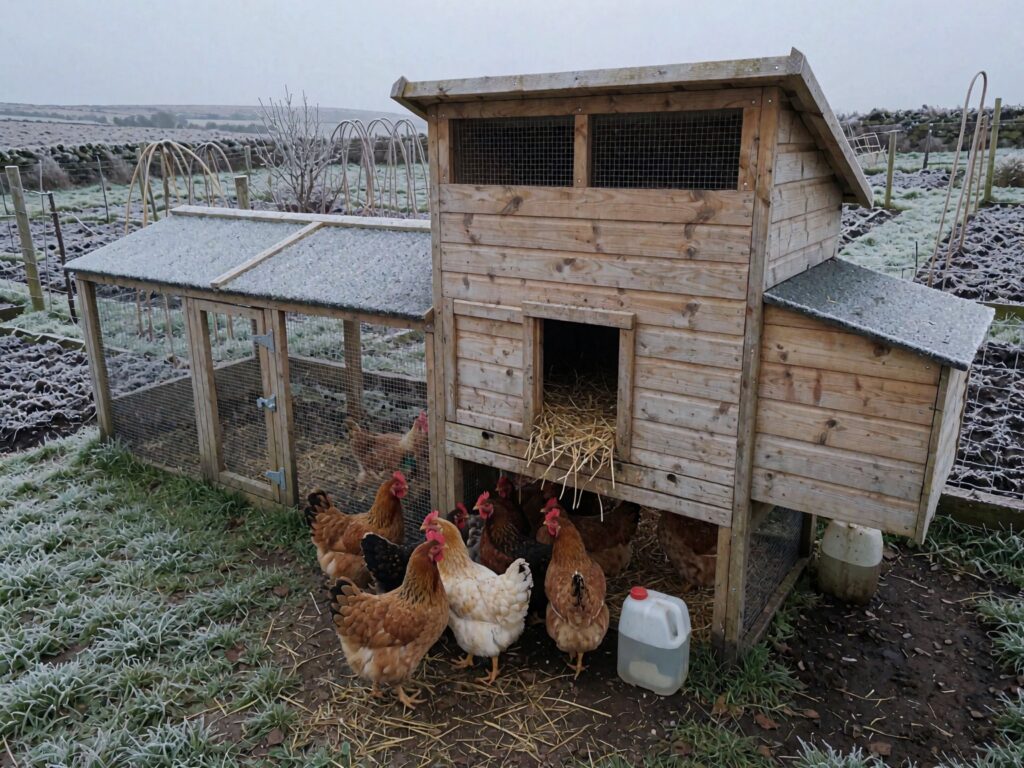
Can hens get through a proper northern winter and still lay you the odd egg for your breakfast? They can, and it comes down to three things, in this order: keep the coop dry rather than warm, stop the water freezing twice a day without fail, and accept that a hen laying less once the light goes is not a problem to solve, it is just what hens do. Everything else is detail.
Can you actually keep hens on an allotment?
This is the one I get asked most, usually by someone who has just signed their tenancy and is already picturing eggs on the way home from the plot. The honest answer is that it depends entirely on your site, not on any general rule for England. Allotment sites are run under a tenancy agreement and a set of by-laws drawn up by the council or the allotment association that holds the lease, and those rules are written plot by plot, not nationally. Some sites allow hens happily. A good many do not allow livestock of any kind, and almost none allow a cockerel, since a cockerel crowing at five in the morning is the fastest way to turn a quiet allotment committee against you.
Before you spend a penny on a coop, go and ask your site secretary or read your tenancy agreement properly, not the summary leaflet. Ask specifically about hens, about fencing requirements, and about how close you can keep them to a neighbouring plot, because that last one is often the real sticking point even where hens are technically allowed. If your site does permit them, the standard that most committees expect is a secure, covered run, a water supply you manage yourself, and no smell or mess straying onto the next plot. Treat that as a minimum, not a target to just scrape past.
If your site says no, I would not try to argue the point. A back garden run, even a small one, with a weatherproof coop in the corner, does the same job and keeps the peace with people you will be seeing every weekend for years.
Keeping the coop dry and draught free, not hot
The mistake I see most, and one I made myself the first winter I had hens up here, is trying to keep them warm. Hens are better insulated than we are, feathers fluffed up over a layer of trapped air, and most breeds you would keep in this country cope with proper cold perfectly well. What kills hens in winter is not the cold itself, it is damp, draught at floor level, and ammonia building up in a coop that is sealed too tight to breathe. A coop with good ventilation up high, where the warm air and moisture can escape, but no draught blowing straight across the roosting bars at hen height, is what you are aiming for.
Deep litter helps a great deal through the worst months. A good thick layer of straw or wood shavings on the coop floor, topped up rather than fully mucked out every week, rots down slowly and actually gives off a little warmth of its own as it breaks down, the same principle as a compost heap. Garden Organic has written about exactly that process for the compost bin, and it holds just as true inside a hen house. Keep the nest boxes separately bedded and dry, since a damp nest box is where you will start finding dirty eggs, and check the roof and any gaps round doors before the weather turns rather than after, because once a coop is properly wet through it stays that way until spring.
Up here on the edge of the moor, at around 200 metres, I reckon on the first properly hard frost arriving by the back end of October. If you are down on lower ground, a good 150 to 200 metres below me, bring that forward a couple of weeks. Higher than that, and you can expect it roughly a week later for every 100 metres you climb. I check that against the Met Office’s own records for this part of Yorkshire rather than just trusting the kitchen window, though Whisky generally knows before either of us, and takes to sulking by the stove the day it turns.
Foxes get hungrier and bolder as the weather turns and natural food gets scarce, so this is also the season to walk the whole run fence on your knees, not just glance at it, checking for anything a determined fox could dig under or push through in the dark.
Stopping the water from freezing solid
A hen that cannot drink stops laying within a day or two and can come to real harm within a week, so this, more than anything, is the daily job that cannot slip. A flat open drinker will freeze solid on a hard night even in a sheltered spot, and chipping ice out of a metal drinker twice a day in the dark before work gets old fast.
A few things make it manageable. A rubber or flexible plastic drinker, rather than metal, lets you simply press the ice out from underneath without having to defrost the whole thing, which is the single cheapest improvement you can make. Position the drinker out of the wind and, where you can, off the ground on a brick or block, since cold travels up through frozen ground far more than it comes down from the air. Moving water resists freezing longer than still water, so for anyone with an electric supply to the run, a proper poultry drinker base with a thermostatically controlled heating element underneath is worth the cost over a winter with a long hard spell. For anyone without power out there, it comes down to two checks a day without exception, morning and last thing, and a spare drinker already filled and waiting by the back door so a frozen one can be swapped out in seconds rather than thawed on the spot.
Light, laying, and giving them a proper rest
Hens are triggered to lay by day length, needing something close to fourteen hours of light before their bodies commit to producing an egg, and as the nights draw in, that simply is not on offer. A lot of hens will slow right down or stop altogether between late autumn and the turn of the year, and for most breeds kept in a back garden or a plot, this coincides with their annual moult, when they are growing a fresh set of feathers instead and have little spare energy for eggs on top of that.
You will see keepers put a lamp on a timer in the coop to stretch the daylight artificially and keep eggs coming through winter. I do not do it at High Intake, and I would not encourage it either. A hen’s body is built around a rest in the dark months, the same as the ground itself is resting, and pushing her to keep laying through it over several winters running tends to shorten her working life. A small drop in eggs for a few months is not a fault needing fixing, it is simply autumn and winter doing what they do, and she will pick back up on her own once the light starts stretching again after the shortest day.
So, back to where we started: a dry coop with no draught at hen height, water you never let freeze over for more than a few minutes, and a hen left to rest through the dark months rather than coaxed into laying against her own clock. Get those three right, whether you are up on an exposed plot or down in a sheltered garden, and your hens will see out a hard northern winter perfectly comfortably, and so, with a bit of luck, will you.
